
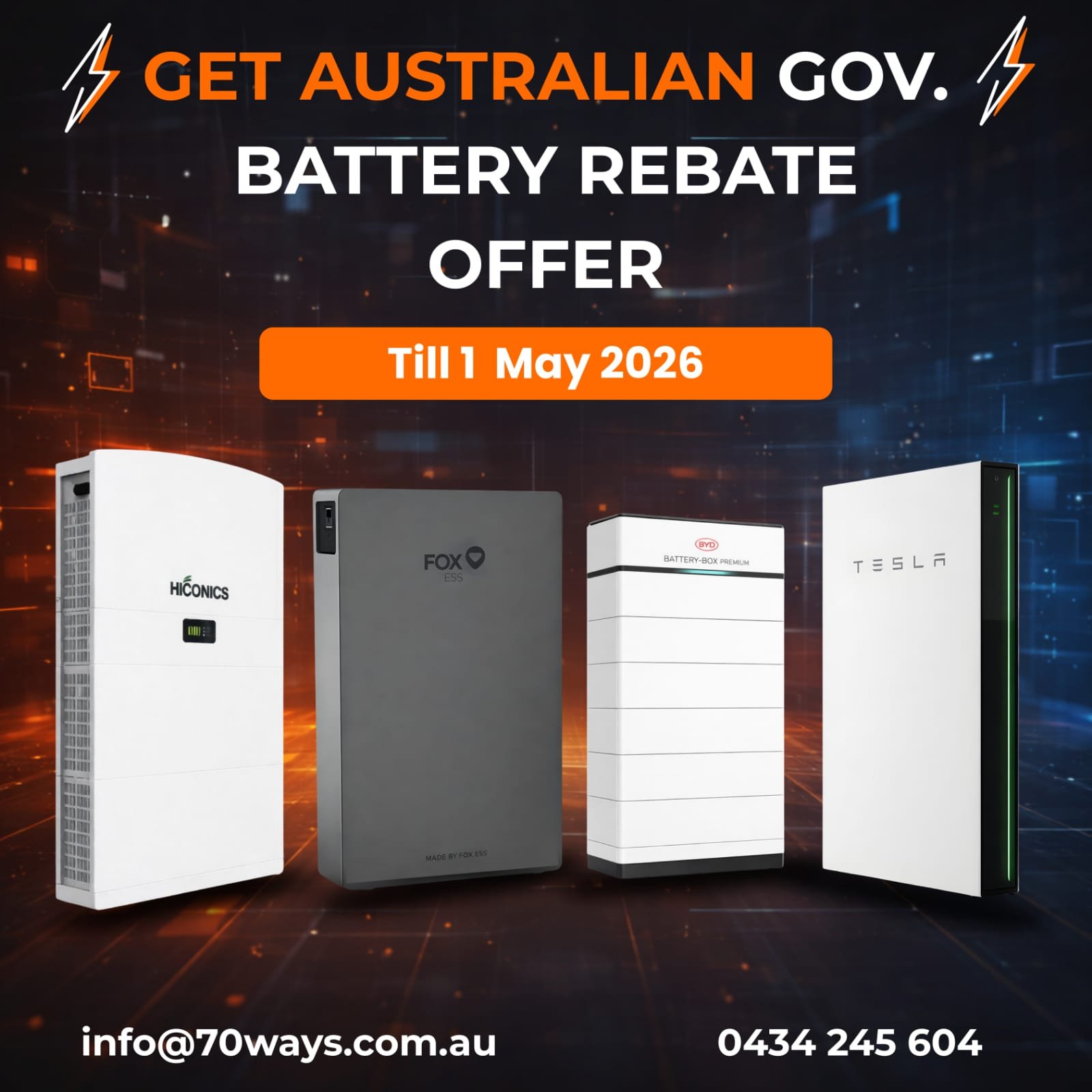
The 2026 Energy Shift: Is Your Home Ready?
As of March 2026, the Australian energy market is hitting a critical turning point. While rooftop solar has reached record installations, the focus has shifted entirely to Energy Independence. With the federal government’s Cheaper Home Batteries Program crossing the 250,000 installation milestone, homeowners are racing against a ticking clock.
At 70ways, we are helping Australians navigate the most significant policy update of the decade: the May 1st Rebate Restructure.
Why May 1, 2026, is the Most Important Date for Your Wallet
The federal government is changing how rebates are calculated to favor smaller, smarter systems. If you wait until after May, your out-of-pocket costs could rise by thousands.
The New Tiered Rebate System Explained
Starting May 1st, the Small-scale Technology Certificate (STC) factor for batteries is decreasing. Here’s how it affects you:
-
Tier 1 (Up to 14kWh): You still receive 100% of the incentive (approx. $4,000 – $4,500).
-
Tier 2 (14kWh – 28kWh): The rebate rate drops to 60% for this bracket.
-
Tier 3 (Above 28kWh): Incentives fall to just 15%.
70ways Insight: If you have a large home or use high amounts of energy at night, installing a 20kWh+ system before May 1st is the only way to lock in the full $8,000+ subsidy.
Top 3 Solar Battery Trends Dominating 2026
To rank as a “Smart Home” in 2026, your system needs to do more than just store power. At 70ways, we prioritize these three technologies:
1. AI-Driven Energy Management
Modern batteries now come with “Smart Brains.” These AI systems analyze weather forecasts and your historical usage to decide when to store power and when to sell it back to the grid for maximum profit.
2. VPP Readiness (Virtual Power Plants)
In 2026, you can’t claim a federal rebate unless your battery is VPP capable. By joining a VPP, 70ways customers are earning up to $1.00 per kWh during grid events, effectively turning their battery into a secondary income stream.
3. Vehicle-to-Home (V2H) Integration
With EV adoption at an all-time high, your car is now part of your home’s backup plan. 2026 hardware allows you to use your EV’s massive battery to run your house during a blackout.
How to Choose the Best Solar Battery in 2026
| Feature | Tesla Powerwall 3 | Sungrow SBR | Anker SOLIX X1 |
| Best For | Premium Performance | Best Value | Max Efficiency/EV-Ready |
| Capacity | 13.5 kWh | 9.6 – 25.6 kWh | 5 – 180 kWh |
| Warranty | 10 Years | 10 Years | 15 Years |
The Verdict: Passive Saving vs. Active Earning
The 2026 energy market rewards the “active” homeowner. Gone are the days of low feed-in tariffs. Today, it’s about self-consumption and grid participation.
70ways is committed to helping you transition from a consumer to a “Prosumer.” Don’t let the May 1st deadline pass you by—the difference between acting now and waiting could be over $4,000.